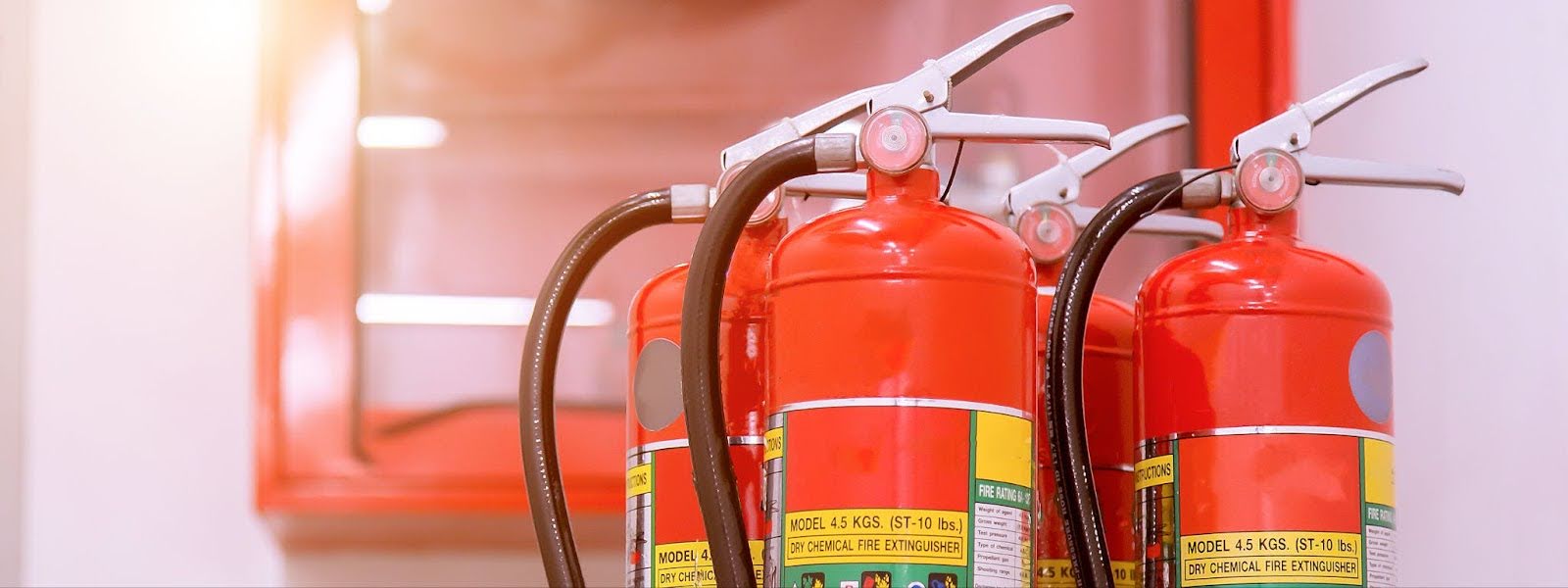
Fire extinguishers are an important part of every building’s fire safety equipment. Correct usage of these devices enables prompt suppression of emerging fires. However, if incorrectly chosen for the fire risks within a building, they could put occupants at greater risk and do little to slow the spread of fire.
Fire extinguishers are categorised by colour bands in Australia which designate the fire type they are capable of extinguishing. Australian Fire Safety Standards specify the classes of fire extinguishers suitable for different types of buildings and fire risks. They provide detailed guidelines on the identification, placement and maintenance of fire extinguishers throughout their service lives.
Building owners, facility managers and employers should familiarise themselves with fire classes and fire extinguisher colour codes to meet their legal responsibilities and help occupants react quickly and effectively if a fire occurs.
Regular inspection and servicing are essential to confirm extinguishers are suitable for the specific fire risks present within a building and will perform as intended when required.
Below is our complete guide to fire extinguisher classes and colour bands, including ABE dry chemical powder extinguishers, carbon dioxide (CO₂) fire extinguishers, foam extinguishers, water fire extinguishers and wet chemical fire extinguishers. Learn how each type operates, the types of fire they are capable of controlling and where they should be installed to keep your workplace safe, compliant and prepared.
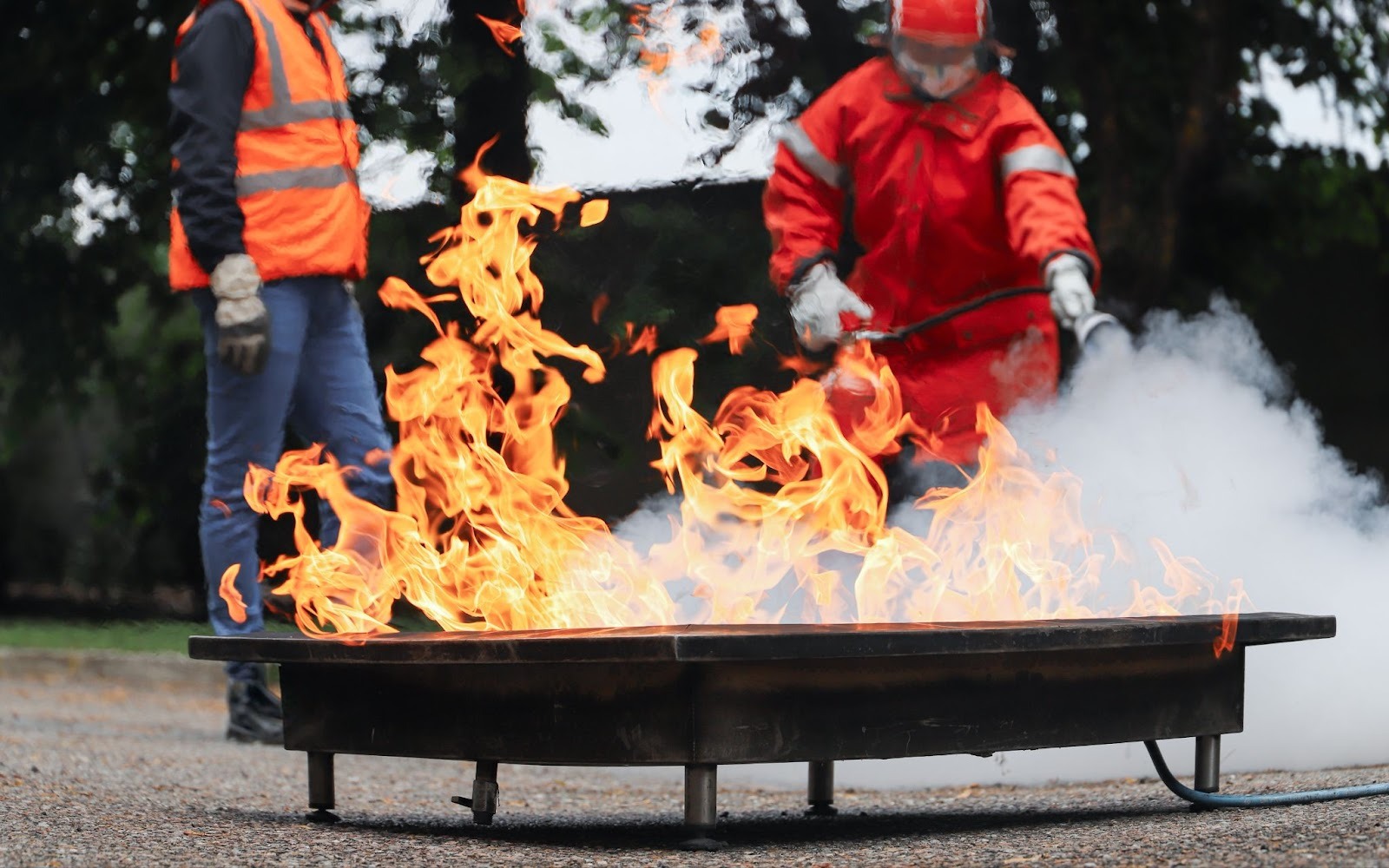
Fire extinguisher classes categorise fires depending on fuel type. Fire classifications provide helpful information when determining the suitability of fire extinguishers for different fire risks. By learning the differences between fire classes, you can choose the correct fire extinguisher based on the types of fuel located throughout your premises.
Class A fires involve solid combustibles like wood, paper, cardboard, textiles and plastics.
Class B fires include flammable liquids like petrol, oils, solvents, paints and fuels of any kind.
Class C include flammable gases such as LPG, propane and butane. Again, the best method of control is isolation of the gas if safely possible.
Class D involves combustible metals such as magnesium, aluminium, sodium and potassium. Class D fires are relatively rare for most businesses but should be considered if you work with these materials on-site.
Class E involves fires where the fuel source is energised electrical equipment. Although electricity doesn’t burn, it can pose serious risks to occupants if water or conductive agents are used during firefighting. Class E-rated fire extinguishers are non-conductive and can be safely used on live electrical equipment.
Class F fires include cooking oils and fats. Usually found within commercial kitchen environments.
As you can see, fire classes refer to the type of fuel that’s burning. Whereas fire extinguishers refer to the agent’s fire suppression capabilities. Different suppression agents tackle fires differently, which is why there are multiple fire classes.
Selecting an inappropriate fire extinguisher can make a fire worse or be completely useless against certain fire classes. Ensuring you have the right fire extinguisher for the right fire classes reduces overall risk to your occupants and guarantees your fire extinguishers will perform correctly should the need arise.
Fire extinguishers are classified in Australia under AS1841, which sets standards for portable fire extinguishers, including classifications, labelling, and colour coding. Under AS1841 standards, all fire extinguishers must have a red body with a coloured band to identify what type of extinguishing agent is inside the fire extinguisher.
The red body allows extinguishers to be universally recognised as emergency equipment, while the coloured band allows the classification of fire extinguisher type to be quickly visible. This allows people in the building, fire wardens or emergency services to quickly identify and grab the correct fire extinguisher without having to worry about reading instructions or finding the correct label during an emergency.
The different colour bandings used for fire extinguishers in Australia are:
ABE dry chemical powder fire extinguisher. Suitable for Class A, B and E fires.
Carbon Dioxide (CO₂) fire extinguisher. Most commonly used for Class B and electrical fires.
Foam fire extinguisher. Used for Class A and B fires.
Water fire extinguisher. Suitable for Class A fires only.
Wet Chemical fire extinguisher. Wet Chemical extinguishers are suitable for Class F fires and are commonly found in commercial kitchens.
Labels are still required by AS1841 which include fire class ratings and clear instructions on operating the extinguisher. It’s important that the colour band and label are used together and are clearly visible and legible. Some facilities choose to rely solely on the colour band, but this is not recommended. When fire extinguishers get painted over, stored in cabinets or located in poorly lit areas it can make identification difficult.
Colour coding will be inspected during your fire equipment services inspections and audits.
ABE dry chemical powder extinguishers are identified by a white colour band and are rated for use on Class A, Class B and Class E fires. This multi-class capability makes them suitable for environments where combustible solids, flammable liquids and energised electrical equipment may all present a fire risk.
Their non-conductive properties allow them to be safely used on live electrical equipment, which is particularly important in workplaces where fire detection systems, fire indicator panels, and fire alarms in the workplace rely on a continuous electrical supply.
Colour Band: White
Fire Classes Covered: A, B, E
ABE extinguishers work by removing the chemical chain reaction produced by a fire. When discharged, the extinguisher releases a fine powder that suppresses combustion by effectively “blanketing” the fire and stopping the chemical reaction that allows it to burn.
This allows it to quickly control and ultimately extinguish the fire. It doesn’t conduct electricity, so it will not short-circuit or conduct energy from an electrical source. ABE extinguishers are typically used in areas where other types of extinguishers are ineffective, or where isolating power is not an option.
ABE dry powder extinguishers can be found in many locations around commercial properties. They are ideal for installation in plant rooms, switch rooms, and service corridors due to their multiple application across different classes of fire. Owing to their ability to tackle different classes of fire, they are often used to provide general coverage of the workplace.
Dry powder extinguishers leave a large amount of residue on equipment, machinery and electrical components. The powder should be cleaned after use as it can cause damage if left.
Use of dry powder should be avoided in confined areas, as visibility may be reduced when using the extinguisher. Allow persons to evacuate the area first if possible. Due to these reasons they are not recommended for confined food preparation areas.
ABE dry powder extinguishers comply with Australian Standards when installed and maintained correctly. Have professionals inspect your extinguishers regularly to ensure they are still at the correct pressure, the body is in good condition and the seal has not been broken.
The guidelines set out in AS1851 state that in the event of a fire extinguisher being discharged, even partially, it must be taken to a fire equipment supplier to be inspected, cleaned or replaced if necessary. Leaving residue from powder extinguishers can cause you to become non-compliant.
Carbon dioxide fire extinguishers are used in atmospheres where there is a risk of fire from flammable liquids and energised electrical equipment, when the damage caused by the residue of other extinguishing agents is unacceptable. According to AS1841 standards carbon dioxide fire extinguishers with a black colour band serve as the primary clean-agent fire control solution for technical environments.
Colour Band: Black
Fire Classes Covered: B, E
Carbon dioxide fire extinguishers remove oxygen from the fire zone. On discharge, carbon dioxide quickly blankets the flame and displaces the oxygen feeding it. The fire is suffocated at the source as the oxygen level is dropped below that which is required to maintain combustion.
CO₂ discharge also allows for rapid cooling at the flame front due to expansion of the gas as it is released under pressure. This provides some level of cooling however does not significantly cool the surrounding material.
Due to their non-corrosive and non-conductive discharge by-product CO₂ fire extinguishers are common within server rooms, data centres, communication rooms and other critical facilities.
Units are often mounted close to electrical cabinets, control panels and switchboards. Laboratories also regularly use carbon dioxide fire extinguishers where there is a risk of flammable liquids and residue from other extinguishing media cannot be tolerated.
Carbon dioxide extinguishers can often be found used in conjunction with fire suppression systems. Where detection, fire alarm and automatic fire control processes are installed, extinguishers provide first response to firefighting.
Carbon dioxide will displace oxygen. As a result, if discharged in a confined area there is the potential for the space to become oxygen-deficient causing an asphyxiation risk to those present. When using CO₂ extinguishers occupants should ensure they discharge for the shortest amount of time possible and vacate the area when fire is under control.
Due to there being no cooling effect after application CO₂ extinguishers also do not offer any post-fire control. As such materials will remain at a high temperature and will likely re-ignite if exposed to an ignition source.
As pressurised containers carbon dioxide fire extinguishers are required to be hydrostatically tested in accordance with Australian Standards for pressure vessels. This process validates the integrity of the cylinder itself and ensures the extinguisher can safely contain pressure.
Cylinders must also be examined to ensure the valve and discharge horn are in good working order, correctly labelled and have no signs of damage or corrosion.
Foam fire extinguishers are multipurpose extinguishers which can be used on Class A fires (solid materials such as wood, paper or textiles) and Class B fires (flammable liquids). Due to their versatility they can be used in locations where both of these fire risks are present. Foam fire extinguishers are identified by a blue colour band. AS1841-compatible foams extinguish surface fires effectively and greatly reduce the risk of re-flash.
Colour Band: Blue
Fire Classes Covered: A, B
The action of foam extinguishers is by blanketing the burning material with a stable foam. This smothers the fire by denying it oxygen, while cooling the burning material below its ignition temperature. When used on flammable liquid fires, foam also suppresses vapours that can lead to re-flash.
Foam fire extinguishers are ideal for use in locations such as fuel stores, vehicle or mechanical workshops and car parks, where flammable liquids may be stored, used or handled. Foam extinguishers can cope with incidents involving both solid materials and liquid fuels, which may be prevalent in these areas.
Foam extinguishers are often located alongside exit routes and near high-risk areas but should be located considerately so they do not obstruct exits or emergency lighting.
Foam extinguishers should not be used on live electrical equipment as the contents can conduct electricity. If there are electrical fire risks present in an area alternative extinguishers suitable for electrical fires should be located nearby.
Foam extinguishers should not be used in certain chemical hazards where the chemical may interact with the foam to create a greater risk. If you have doubts about the process, you must consult professional advice.
Foam fire extinguishers require regular inspection, testing and maintenance in accordance with AS1851. Visual inspections should be carried out to ensure the extinguisher is in the correct working pressure, has no damage to the hose or discharge nozzle and is clearly legible. Extinguishers should be serviced periodically to ensure the foam is in good condition and has not passed its use-by date.
Older foam fire extinguishers contain PFAS which are harmful to the environment. Newer foam fire extinguishers are available which are designed to have limited or no impact on the environment. Regardless of the type of foam fire extinguisher you have, proper servicing and disposal is important.
Please contact us for a safe disposal method when your foam fire extinguisher has reached its use-by date or has been used.
Water fire extinguishers have no coloured band and are rated for Class A fires only. Class A fire risks include solid combustibles like wood, paper, cardboard, textiles and some plastics. Water fire extinguishers must only be installed where there are no flammable liquids, gas or electrical fire risks.
Colour Band: Solid Red (no band)
Fire Classes Covered: A only
Water fire extinguishers work by cooling the fuel they are applied to below its ignition temperature. These extinguishers do not suppress vapours or remove oxygen, so they are only suitable for use on very specific risks.
Class A fire risks include offices, schools and general commercial indoor use where there is a high likelihood that fires will involve things like paper, furniture and office equipment but a low likelihood of electrical or flammable liquid fires.
Water fire extinguishers are usually provided as part of a suite of essential safety measures intended to help occupants control fires in their early stages and have minimal impact on the environment and ease of use.
Water should never be used on live electrical equipment or flammable liquid fires. If a water extinguisher is used on live electrical equipment, there is a risk that the person using the extinguisher may receive an electric shock.
If a water extinguisher is used on a flammable liquid fire, the fire will likely spread as the burning liquid moves away from the original fire area. Both these situations will cause the fire to rapidly grow larger.
Australian Standards detail how far extinguishers should be placed from travel distances (the distance an occupant would have to travel to reach the extinguisher). However, extinguishers should not be placed so far that occupants hesitate to evacuate to use one. Height, obstruction and visibility of extinguishers should also be considered and they should be located in obvious locations along normal lines of travel.
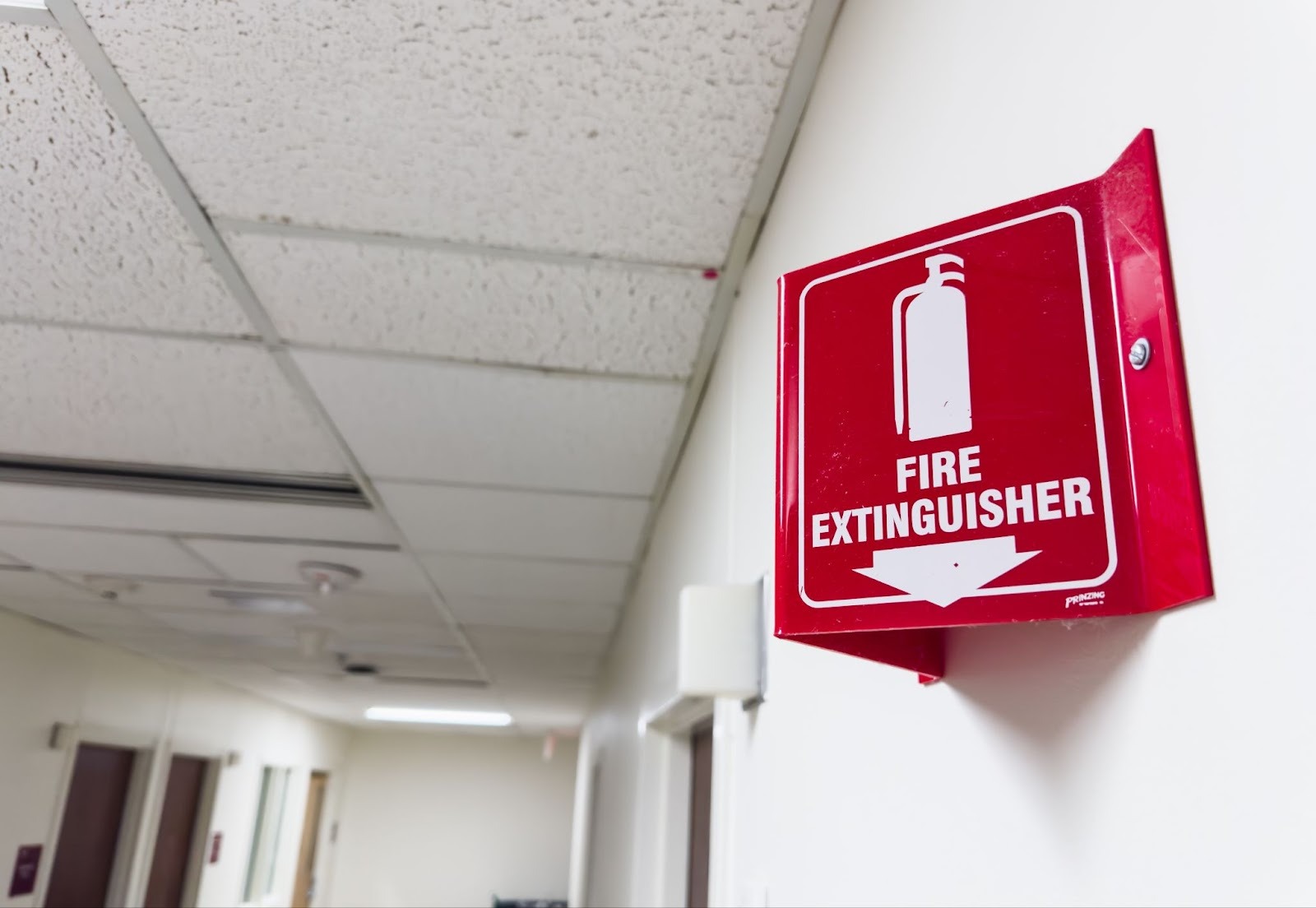
Correct signage should be installed to make occupants aware of extinguisher locations if they are not immediately visible due to building layout or furnishings. As part of the regular inspection and ongoing servicing process a water fire extinguisher’s operating condition will be verified. Signage clarity will be checked, along with the fire extinguisher’s expiry date to ensure it stays compliant and has not passed its use-by date.
Wet chemical extinguishers offer essential protection against cooking oil and fat fires. As standardised by an oatmeal coloured band, wet chemical extinguishers are distinguished from other types under AS1841.
Colour Band: Oatmeal
Fire Classes Covered: F (and A in some cases)
Wet chemical extinguishers are a control measure specifically designed to extinguish high-risk cooking fires. They work by releasing an agent that causes saponification, a chemical reaction that forms a soapy film over burning oil and cuts off its oxygen supply. This film also cools the oil very quickly.
Wet chemical extinguishers are generally required by law in commercial kitchens.
Wet chemical extinguishers must be provided in any workplace risks that use deep fryers, hotplates, or cooking oils. This includes industrial kitchens, food courts, cafes, restaurants, caterers, and other food businesses.
Wet chemical extinguishers must be readily accessible and nearby the cooking risks they are mitigating. They should be installed so that the operator is not put at risk when fighting a fire. Ensuring wet chemical extinguishers are provided in areas with cooking risks is a frequent point inspectors look for, and one that can often be missed.
Wet chemical fire extinguishers are one of three controls that should be provided in a commercial kitchen. Wet chemical extinguishers are usually found alongside fire blankets and fixed kitchen fire suppression systems.
Fire blankets should still be used to control smaller fires or initial flames that may occur within a pan, until the wet chemical fire extinguisher can be used. Staff should be trained to know the difference between when an fire extinguisher should be used, and when a fire blanket is more appropriate. Fire blankets should be regularly tested to ensure they are always in working order.
Wet chemical extinguishers are required to undergo inspection, service, and testing in line with AS1851. Like all portable fire extinguishers, they must bepressure tested, inspected for condition, and have their extinguishing agent checked at set intervals.
As the name suggests, you cannot substitute wet chemical extinguishers for another type of fire extinguisher. Using another fire extinguisher type on a Class F fire will not adequately control the fire and is deemed non-compliant.
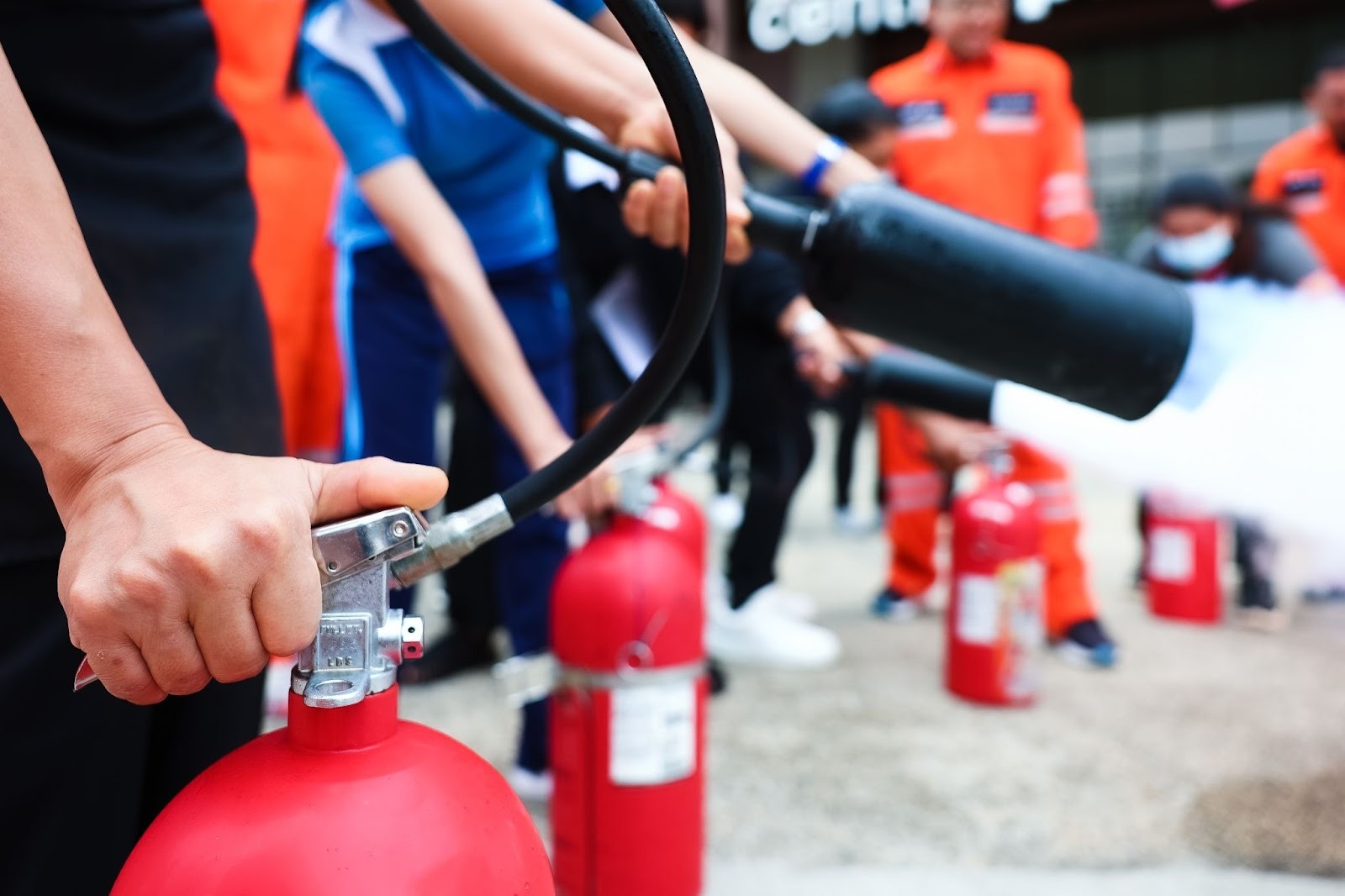
Fire extinguishers are a key part of the fire safety guidelines within your building. Installing the correct extinguisher should be based around your fire risk assessment, not what looks best or easiest to fit. Your risk assessment will identify what materials are stored, what could catch fire, how many people occupy your building and what processes take place there.
For instance, you wouldn’t select the same extinguisher for a kitchen area as you would a computer room. Your building type will determine your fire risk and therefore what class of extinguisher and agent you need to install. Cooking areas such as commercial kitchens or plant rooms will have different fire hazards to that of an office space or high-rise apartment building.
Ensure you comply with your National Construction Code (NCC) and Australian Standards when selecting your fire extinguishers. They should be easily accessible and allow for safe evacuation of the premises where possible.
Your local fire authority or council may also have requirements around what extinguishers you need to install. Additionally, your insurance may require you to have specific extinguishers installed based on fire hazards. They may also require you to provide proof that you have fire protection in place such as extinguishers, fire alarm testing and tagging, and spray foam systems.
Ensuring you have the right extinguishers in place based on your fire assessment not only provides you and your team with peace of mind but can reduce the likelihood of your fire insurance being used. Always ensure you follow best practices and your local laws when selecting fire extinguishers.
If you have multiple storeys or a high occupancy building like an office building, inner city apartments, mixed retail spaces you should have a fire safety plan. This fire safety plan should involve where extinguishers are located, fire detection systems, evacuation points and fire wardens.
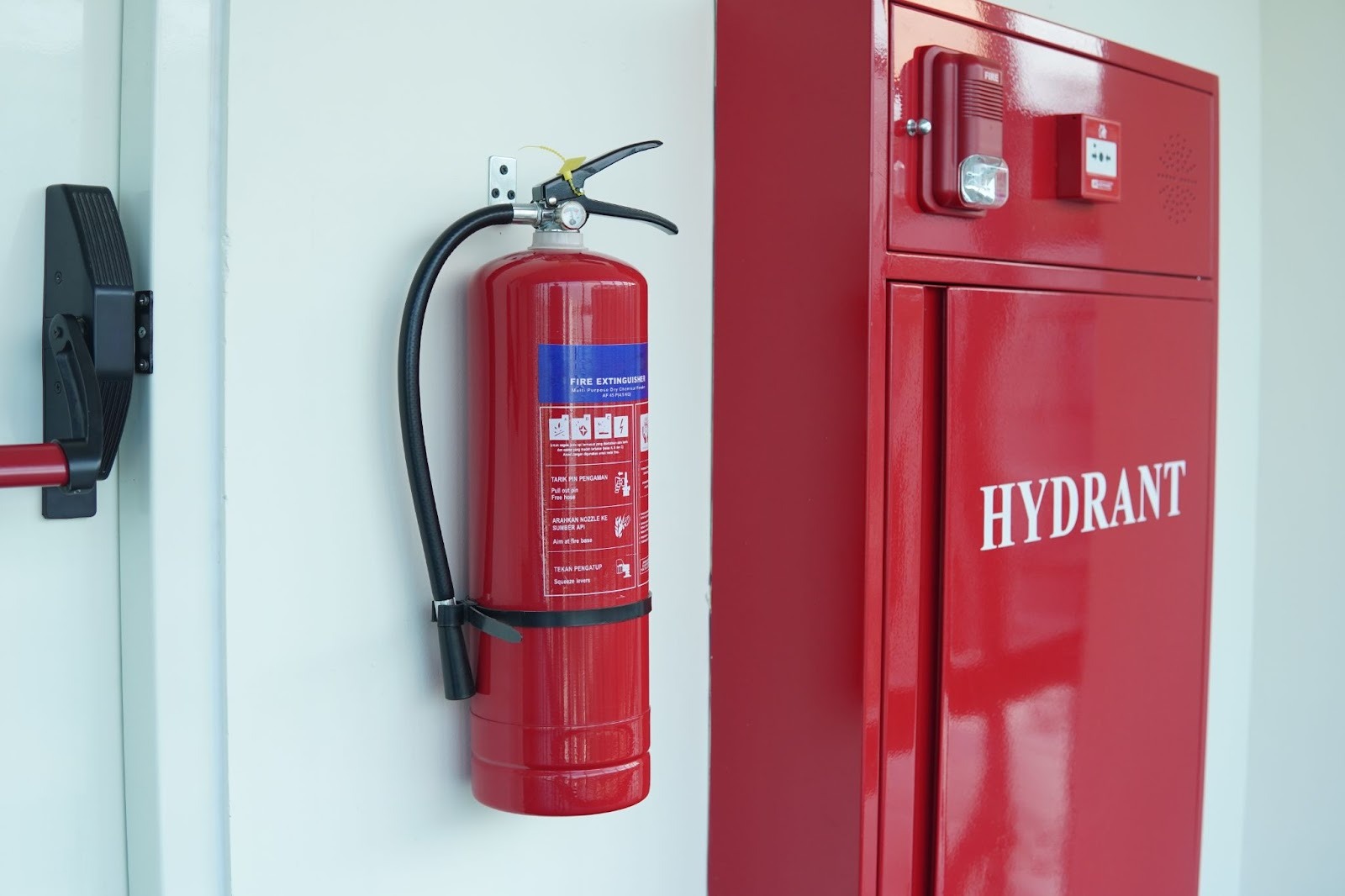
Fire extinguisher placement in Australian buildings must comply with AS2444: Portable Fire Extinguishers and Fire Blankets – Selection and Location, which specifies requirements for installation, mounting, visibility, accessibility, and spacing to ensure extinguishers are available and usable in an emergency.
Installation of extinguishers should be with the carrying handle positioned at a height not exceeding:
Mounting should not obstruct and be suitable for the intended location; not be placed in areas where they may be inadvertently damaged or interfered with.
AS2444 allows travel distances to an extinguisher depending on the classification of fire and occupancy:
Fire extinguishers should be visible from all normally accessible directions. Signs complying with AS2444 should be placed either above or beside the fire extinguisher indicating:
Signage should not be blocked from view, illegible or hard to reach. Signs should be illuminated if they are in a low-light area.
Extinguishers should be easily accessible and should not be obstructed by furniture, storage or equipment. Install extinguishers along normal routes of travel and nearby areas of high fire risk. Ensure extinguishers are accessible to everyone, including response teams and people with limited reach or mobility.
As part of your monthly inspections, check that extinguishers are easily accessible and have not been moved from their required mounted position.
Fire extinguishers are an important part of a building’s fire protection system, they must be inspected, tested and serviced regularly to comply with regulations and function correctly.
Generally in Australia extinguishers are serviced under AS1851 and linked to AS1670 when they are connected to fire detection, alarms or warning systems.
The servicing and maintenance schedule required by AS1851 is designed to ensure that fire extinguishers are kept in working order, accessible and ready for use. Visual inspections take place once per month to ensure extinguishers are in their correct location, not obstructed, mounted properly and showing no obvious signs of damage or pressure loss. Checking signage is also visible and the tamper seal and pin remain intact.
Every six months, extinguishers should be inspected and serviced by a trained fire technician who will ensure that the extinguisher is in good condition, showing the correct pressure, weighing or measuring the charge to ensure it is adequate, and determine if the extinguisher type is still suitable for the risk it was installed for.
Once per year additional servicing takes place that includes everything in the six monthly inspection as well as checking the internal condition of the extinguisher, inspecting the agent if applicable and ensuring it hasn’t deteriorated and checking that it still meets current standards and requirements. Some extinguisher types also require pressure testing and replacement of parts throughout their life.
AS1670 details maintenance and servicing requirements for fire extinguishers where they are linked to other fire protection systems such as alarms, detection systems and occupant warning devices. This can require inspections and tagging to match the schedules of other tests or documentation for the whole fire system.
It is vital that all inspection and maintenance visits are recorded in compliant logbooks or computerised records. These records act as proof of compliance during fire safety audits and inspections and are often used by insurance companies when assessing risk or reviewing policies.
Maintenance reports often tie into annual statements of compliance such as an Annual Fire Safety Statement (AFSS) or Essential Safety Measures reports. Missing services or untaged extinguishers are one of the most common fire extinguisher related breaches.
Alexon provides inspection, testing, maintenance and compliance services to ensure your fire extinguishers are compliant, in working order and ready for audit.
Mounting the wrong type of extinguisher for your given fire risk is one of the most severe forms of non-compliance. This can often happen where a ‘one size fits all’ solution has been applied without performing a fire risk assessment on the premises. Units found to be unsuitable for use on electrical fires, flammable liquids or cooking oils will fail both compliance and safety-first-response.
Fire extinguishers must be accessible at all times and should never be blocked by furniture, stored items, equipment or temporary walls/partitions. This is another common form of non-compliance spotted on audits. Partially blocked units can slow down response time in an emergency and classifies as non-compliant with AS2444 position guidelines.
If an extinguisher is due, or overdue, for inspection, service or pressure testing it is considered non-compliant and may not work when needed. Missing service tags, or outdated dates are common examples of how your fire safety may not be meeting AS1851 maintenance requirements.
Fire extinguisher signs are a legal requirement as opposed to a visual indicator. Missing or damaged signs make extinguishers harder to locate and identify when lighting is low or in smokey conditions. Signs should state what type of extinguisher is mounted as well as clearly identifying its position per AS2444.
Fire extinguishers mounted at the incorrect height, on unstable brackets or on the floor (where ceiling mounts are required) will be deemed difficult to access or use. This is commonly found in older premises or where refurbishments have taken place and extinguishers have been moved without reassessment.
Fire extinguisher maintenance isn’t a “set and forget” task – it’s a continuous responsibility that spans risk management, regulatory compliance and life safety. Doing it correctly requires educated advice, proper placement and installation, rigorous servicing and record-keeping you can have confidence in.
Our fire equipment maintenance services are designed to support building owners, facility managers and businesses at every step. From risk-assessments that verify suitable fire extinguisher types and placement reduce risk to occupants and assets, to providing expert guidance based on Australian Standards and the NCC. We’ll even implement a scheduled maintenance program to keep your systems fully serviceable and compliant with your audit requirements.
Utilising our services means you’ll have an expert maintaining your fire extinguishers year-round. Everything from inspections, testing and servicing will be performed in accordance with AS1851, and your records will be maintained to help you confidently meet audit, insurance and statutory obligations. That means you can rest easy knowing your fire extinguishers have been professionally maintained by experts, rather than having missed inspections, incorrect installations or missing documentation.
Don’t leave your fire safety up to chance. Contact Alexon today to make sure your fire extinguishers are compliant, reliable, and ready to perform when you need them.
Complete the form to request a call
from a friendly Alexon team member.


